A Calm Household Contact List for a Busy Week
A calm household contact list for a busy week puts essential people and details in one readable place, so anyone at home can make the next call.
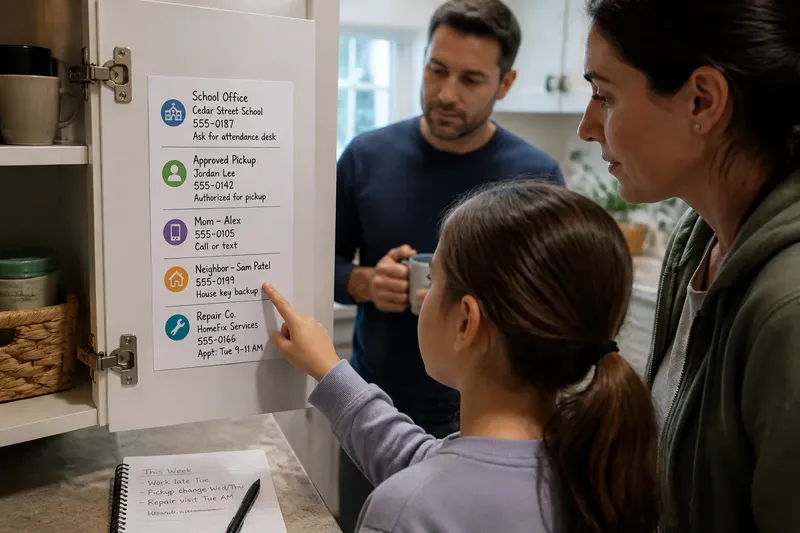
A calm household contact list for a busy week is useful only if someone can read it quickly and tell which number to call. Imagine an invented household preparing for a week when work shifts, school pickups, and a home repair appointment overlap. Their aim is not to build a directory of everyone they know; it is to make a small, clear reference that another household member can use without guessing.
That distinction shapes the whole exercise. A contact list is not a substitute for emergency services, a family calendar, or a care plan. It is a bridge between a changed routine and the person who can help with the next practical task. The invented household below makes choices, checks the result, and leaves out details that would make the page harder to use or unnecessarily expose private information.
What makes a contact list useful during a busy week?
The household begins by asking what someone might need to do if the usual person is unavailable. Perhaps a child needs to be collected, a neighbor needs to know about a delivery, or a contractor needs to confirm an appointment. Each likely need points to a contact. A name belongs on the page when it helps someone take a sensible next action.
This keeps the list from becoming a collection of numbers without context. A phone number alone may not tell a tired household member whether to call a school office, a caregiver, or a relative. A short role beside the name supplies that context. Think of the labels as dividers in a kitchen drawer: they make the useful item easier to locate without adding much clutter.
For the invented household, the week has a changed pickup arrangement, an adult working late, and a scheduled repair visit. They choose a school office contact, the approved pickup person, an adult household member, a nearby relative, and the repair company’s scheduling line. They do not add every friend, service provider, or extended family member. The small set reflects the week’s actual responsibilities.
Who belongs on the page, and why?
Start with people and organizations connected to a specific responsibility. Depending on the household, useful entries might include:
- Household members: the people who may need to coordinate, with a direct number if it is not already easy to find.
- School or care contacts: the main office or relevant program, plus a person authorized to help with pickup if that arrangement applies.
- Nearby support: a trusted neighbor or relative who has agreed to be contacted for a particular kind of help.
- Scheduled services: a contractor, pet-care provider, or other service contact needed during the unusual week.
- Essential care contacts: a clinic, pharmacy, or caregiver only when the household needs that information for an expected task.
These are options, not a universal roster. A single adult household may need a neighbor and a building manager; a household with children may need school contacts; someone caring for a pet may need the sitter’s number. If no likely task connects an entry to the week, leave it off. For urgent emergencies, use the appropriate local emergency service rather than relying on a personal contact list.
Permission matters as much as usefulness. The invented household checks that the pickup person has agreed to the arrangement and that the neighbor is comfortable being listed. They write down only information needed for the contact’s role. A list shared across a household should not imply that an entry is authorized to make decisions that the person has not agreed to make.
How should each entry be written?
Use a consistent pattern that a reader can scan: role — name — best number — useful note. For example, “School office — Cedar Street School — main line — ask for attendance desk” gives a caller a destination and a simple prompt. The example is invented; the household would use its own school’s correct name and contact details.
Keep notes short and action-oriented. “Call after the office opens” may help with a routine matter; a long account of the household’s schedule probably will not. If a contact has more than one number, identify the preferred one instead of presenting an unexplained cluster. Use large, clear lettering and enough space between entries to avoid reading one line as part of another.
Names should match what household members recognize. If a service is usually known by a company name, write that name rather than a staff member’s name who may change. If a person is listed by relationship, include their name too when that prevents confusion. Avoid private details such as access codes, full medical histories, or account credentials. The contact sheet should help someone place a call, not expose information that the task does not require.
Where should the list live?
Choose a place that is both easy to find and appropriate for the information on it. A paper copy on a household notice board may suit a shared home, while a saved note or contact group may work better for people who coordinate by phone. Some households will use both: a concise paper sheet for a visitor or caregiver and a private digital copy for household members.
Visibility should be deliberate. A sheet in a public-facing window or beside an exterior entrance could reveal names and routines to people who do not need them. The invented household puts its paper copy inside a kitchen cupboard door that all household members know to check. It shares the digital version only with the people expected to use it and avoids placing sensitive notes in a broadly accessible group.
Make the location part of an ordinary conversation. Tell household members where the list is, what it covers, and when they should use another source. A visitor who has not been told about the sheet cannot be expected to find it. The placement is successful when the intended reader can reach it without searching, while a casual visitor does not encounter details that serve no purpose for them.
What should the household review before relying on it?
The invented household reviews the draft against the week’s actual calendar and asks whether each entry supports a likely task. They check names and numbers against current contact information, confirm that the pickup arrangement is still approved, and remove a repair contact for a service that has been rescheduled. They also read the sheet from the perspective of someone who did not create it: would that person know whom to call first and what to say?
Reviewing is not an invitation to add every contingency. The goal is a usable reference, not a complete record of household life. A contact list that grows beyond the week’s needs can bury the one number someone is trying to locate. If an important detail belongs in a separate care plan, calendar, or official form, point to that resource rather than copying it all onto this page.
For contact details, permissions, and procedures that depend on an organization’s rules or local requirements, follow the relevant organization’s instructions. That is particularly important for school pickup arrangements and care-related information. A household list can support those arrangements, but it does not replace the official process.
Which small questions are worth asking?
Should emergency numbers go on the household contact list?
Use the appropriate local emergency number for urgent danger, and do not make a personal contact the substitute. A household may include non-emergency service contacts when they support a specific task during the week.
Should the list include full addresses?
Include an address only if the intended user needs it to complete a task, such as identifying a service location. If the list is visible to others, leave out details that are not needed and keep any fuller record in a suitably private place.
Is a digital list enough?
It can be, if the people who need it know where it is and can access it when needed. A paper copy can help a visitor or caregiver who will not use the household’s devices, but its placement should protect the information from casual view.
How often should the list be updated?
Review it when the week’s arrangements change and whenever a listed number, role, or permission changes. A quick check before sharing the list helps catch details that were correct for an earlier plan but no longer apply.
What did the invented household learn?
By the end of the invented situation, the household has a short sheet with recognizable roles, current contact details, and notes that help a reader begin a call. A household member can see who handles pickup, which number belongs to the repair appointment, and where the shared copy lives. The result is not a promise that every disruption will be simple; it is a reduction in avoidable searching and uncertainty.
The useful lesson is to make the list serve the week, not the other way around. When schedules settle, remove entries that no longer support a current task. When a new unusual arrangement begins, revise the relevant lines rather than carrying stale details forward. A calm household contact list stays calm because it remains small, readable, and tied to decisions someone may actually need to make.
Before leaving the finished sheet in its chosen place, ask one final question: could another household member use it without asking its author to explain the labels? If the answer is no, simplify a role name or add a brief cue. That last edit often matters more than adding another contact.