Before the Suitcase: How Luggage Tags Help Travelers Recognize Their Bags
Learn how luggage tags evolved from improvised marks into travel aids, and choose a discreet way to recognize your bag and help it find its way back.
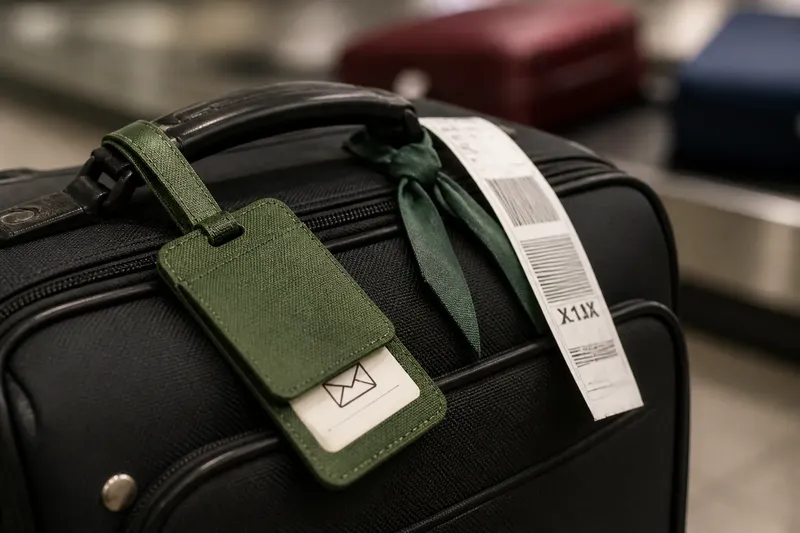
A luggage tag is most useful when it helps you recognize a bag without advertising your personal details. The history of luggage tags is difficult to reduce to a single invention or timeline: travelers and carriers have used different labels for identification and baggage handling, and the surviving forms vary by place and period.
How did travelers mark bags before modern tags?
Before durable, standardized tags became familiar, travelers could use handwritten labels, tied-on cards, painted marks, or other improvised identifiers. A name or destination on a scrap of paper might be fastened to a handle with string. Such a label was easy to make, but its usefulness depended on legible writing and a secure attachment.
Distinctive marks served another purpose. A traveler could recognize a case by its color, shape, initials, or a ribbon on the handle. Those clues helped distinguish one bag from similar luggage, but did not necessarily tell staff where it should go. Recognition and routing were related tasks, not identical ones.
As baggage handling became more organized in different travel settings, labels and tickets could form part of the process for sorting or reclaiming luggage. The details and timing differed across carriers and locations, so it is safer to describe this as a gradual shift than to assign it to one invention. A personal mark might help an owner identify a case; a carrier’s label served the carrier’s handling system.
What changed as luggage tags became familiar?
Tags took on more specialized roles. Carrier-issued labels could carry information used for baggage handling, while travelers used personal tags to distinguish their belongings or provide a way to contact them. The two may be attached to the same bag, but they do different work.
A carrier-issued claim tag or routing label belongs to the baggage process; keep it and follow the carrier’s instructions. A personal luggage tag is a recognition aid, not a substitute for the carrier’s label or baggage records.
A bright tag can help you spot a suitcase on a carousel, while discreet contact details may help someone reach you if the bag is misplaced. A personal tag is a little like a bookplate: it connects an object with its owner without needing to tell a stranger the owner’s whole story.
How should you mark a bag now?
Start with recognition, then consider what contact information is genuinely useful. Choose a color, shape, or texture you can identify quickly. For contact, use details you are comfortable sharing, such as an email address or phone number; leave out a home address, travel dates, and itinerary.
Attach the tag to a sturdy point where you can see it, while avoiding a placement that is likely to snag or obstruct carrier labels. Check that the fastening closes securely and that any card remains readable. A strap or small ribbon can provide another recognition cue, but should not cover required labels or interfere with a handle.
If you prefer not to display contact details, choose a tag with a flap or internal sleeve. Keep a non-sensitive mark visible on the outside and contact information inside. Follow the carrier’s instructions for baggage identification.
Which luggage tag details should you check?
- Visible marker: Check whether the color or pattern stands apart from bags you expect to see; if it does, use it as a recognition cue, and if it does not, choose a more distinctive marker.
- Attachment: Check whether the loop or buckle closes firmly and sits on a sturdy point; if it does, keep it there, and if it feels loose or catches, replace it or move the tag.
- Contact details: Check whether the information gives a finder a reasonable way to reach you without exposing unnecessary personal details; if it does, keep it, and if it reveals more than you want, remove or cover those details.
- Card protection: Check whether the sleeve keeps writing legible and out of casual view; if it does, use it, and if the card is exposed or hard to read, choose a covered tag or replace the insert.
- Backup cue: Check whether a second mark, such as a strap or ribbon, remains visible if the tag turns inward; if it does, keep the pairing, and if it obscures a carrier label or handle, move or remove it.
- Carrier labels: Check whether personal tags leave carrier labels and claim information unobstructed; if they do, leave the arrangement in place, and if they overlap, reposition the personal tag.
What if two bags look alike?
Say you have a plain black suitcase and expect to collect it among similar dark cases. You start with a green fabric tag, a covered contact card bearing an email address, and a narrow matching strap. You attach the tag to a sturdy handle, check that the strap does not cover the carrier label, and tug the tag gently to confirm it stays in place. At pickup, the green tag and strap give you two visible cues; if either is hidden, you pause and check a private identifier before taking the bag. The tradeoff is straightforward: visible markers aid recognition, while covered contact details are less exposed but may take an extra moment to consult.
If you are helping another traveler, ask them to describe a distinctive feature rather than calling out a full name or reading a contact card aloud. If a bag appears to belong to someone else, leave it where it is and alert carrier staff rather than opening it. A tag supports recognition; it does not prove ownership on its own.
How do you choose a tag for your trip?
For a familiar suitcase, a durable tag and a visible marker may be enough. If the bag is likely to be handled repeatedly, favor a protected card and a fastening that does not rely on a delicate cord. On a shared trip, each traveler can choose a different color or symbol while keeping contact details private and consistent with their comfort.
Digital or scannable tags can store more information than a paper card, but they raise questions about access and what happens if the tag is lost. Read the service’s privacy terms before entering personal details. A conventional tag remains a simple choice when you want control over what is written and displayed.
What do travelers ask about luggage tags?
Should a luggage tag show my full name?
It does not have to. Use the least identifying information that still gives a finder a reasonable way to contact you, and keep sensitive details covered when possible.
Are personal luggage tags the same as airline tags?
No. Personal tags help you recognize a bag and provide contact information, while carrier-issued labels support baggage handling. Keep claim tags and other carrier labels as directed.
Where should I attach a luggage tag?
Attach it to a sturdy handle or another secure point where you can spot it without obstructing the carrier’s label. Check that the fastening closes properly and is unlikely to catch during handling.
Is a bright tag better than a name label?
They solve different problems. A bright tag helps you recognize a bag quickly, while contact details can help someone reach its owner; a visible marker paired with discreet information serves both purposes.
The history of the luggage tag is less a story of one universal invention than of two continuing needs: sorting bags and recognizing them. Before you leave, check that your personal tag is secure, its contact card is readable, and carrier labels remain unobstructed. For a luggage tag today, that small distinction keeps the mark useful without asking it to reveal more than necessary.